Regardless of whether researchers approach their field of study from a stimulus, response, or transactional perspective, there is a general recognition that individual differences exist in how individuals respond to stressful situations (Lazarus and Folkman, 1984; McEwen, 1998).
A striking example of this appeared on television during Hurricane Andrew in which the high winds leveled two neighbors’ homes with no loss of life. A news reporter interviewed the middle-aged fathers from both families who were standing in front of slabs of concrete that were once their respective Palm Beach houses.
One man was crying profusely, exclaiming that he had lost everything he had worked for all his life, while the other calmly expressed his thanks that everyone in his family was safe, even the dog.
Clearly, the stressor was identical for these two men, but their responses, at least the responses that were captured by the camera, were quite different. Observations like these lead one to consider individual difference variables that might affect the intensity or pattern of the acute stress response, and theoretically alter risk for subsequent disease processes. Table 3.3. Selected Individual Difference Variables Related to Stress

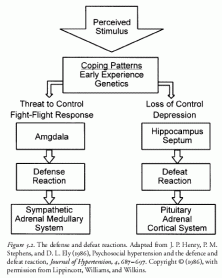
Some individual difference variables that have been examined regarding their association with stress responses are listed in Table 3.3. Figure 3.2. The defense and defeat reactions. Adapted from J. P. Henry, P. M. Stephens, and D. L. Ely (1986), Psychosocial hypertension and the defence and defeat reaction, Journal of Hypertension, 4, 687???697.
For presentation purposes, the individual difference variables that have been examined in the literature have been grouped into three categories: demographic or historic developmental factors that are presumably unchangeable, psychological variables that could be modified through existing behavioral interventions, and social variables that could be modified by changing one’s environmental context.
Although a comprehensive analysis of each individual difference variable will not be attempted, representative references are provided.