There are now over a dozen ambulatory blood pressure monitoring devices that meet the standards established by the Association for the Advancement of Medical Instrumentation (1993) and the British Hypertension Society (O’Brien et al., 1993; 2000). In contrast to the less expensive automated devices used for home monitoring, ambulatory monitors reveal what is truly happening regarding alterations in blood pressure during a patient’s daily life.
There is no need to stop daily activities, take a quiet moment to sit down, attach the cuff properly, and take a few blood pressure recordings. With ambulatory monitors, all these functions are programmed into the instrument and they happen automatically. Data are stored digitally and downloaded into a computer for analysis when the patient returns the device to the clinic. Of course, patients are instructed to remove the device when bathing, swimming, or involved in any contact sports, but otherwise are free to do what they normally would do during any other day.
Initial bulky versions of ambulatory blood pressure monitors that employed the intra-arterial method of assessment were described by researchers in the 1960s (Bevan, Honour, and Stott, 1969; Richardson et al., 1964). These were some of the first studies to document the substantial variability of blood pressures among both hypertensive patients and normotensive controls during the day as well as during the night. As expected, blood pressures typically decrease during the nighttime for both hypertensives and normotensives.
Since that time, significant technological advances have led to the development of a number of ambulatory blood pressure recording devices that are relatively compact, lightweight, noninvasive, quiet, and, most important, accurate (O’Brien et al., 2000). Typically, the device is attached and calibrated during a brief visit to the clinic and patients are instructed to go about their daily life for the subsequent 24 to 48 hours. Calibration with auscultatory readings is essential, as ambulatory blood pressure determinations have been reported to be affected by different constitutional characteristics including obesity, age, and arm circumference (Harshfield et al., 1889).
Even with a properly positioned and calibrated cuff, situations are bound to occur in daily life in which unavoidable body movements or unusual arm positions will influence the accuracy of these determinations, like driving in heavy traffic or sleeping with an arm draped off the edge of the bed. Fortunately, all the ambulatory blood pressure monitors available for clinic or research use have automatic integrated programs for detecting potential sources of invalid measurement and marking these recordings as questionable.
Another very useful adjunctive assessment tool during periods of ambulatory monitoring involves asking the patient to record various contextual factors associated with each blood pressure determination including state of wakefulness, body posture, mood ratings, activity level, and substance use. With this information in hand, clinicians can examine individual blood pressure measures at a later time to investigate patterns between contextual variables and blood pressure levels.
Research employing measurements of these contextual factors, for example, has revealed, not surprisingly, that higher ambulatory blood pressures are likely to occur during periods involving emotional activation (Kamarck et al., 1998) and increased alertness (Shapiro, Jamner, and Goldstein, 1993). Additionally, because DBPs have been shown to be higher during cold versus warm seasons (Giaconi et al., 1989), evaluators should take average daily temperature into account when interpreting results from ambulatory blood pressure monitoring.
Let’s examine the results of Franklin’s ambulatory blood pressure monitoring (see Figure 2.1). During his late morning clinic appointment, an ambulatory blood pressure monitor was attached and calibrated with Franklin’s resting clinic blood pressure. During the single 24-hour monitoring period, 44 valid recordings were made, reflecting considerable variability in his blood pressures over the course of a single day.

The average ambulatory blood pressure was 145/88 mm Hg, suggesting that his ambulatory SBP was comparable to his clinic SBP, but his ambulatory DBP was somewhat lower ( -11 mm Hg) than his clinic DBP. SBPs ranged from 98 to 184 mm Hg, and DBPs ranged from 55 to 113 mm Hg. Combining the ambulatory blood pressure profile depicted in Figure 2.1 with Franklin’s diary of contextual factors revealed some additional and worthwhile data. First, two peaks in DBP occurred later in the afternoon.
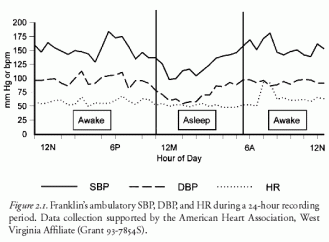
According to his diary, the first peak was associated with driving, and the second with a prolonged confrontation with a co-worker. Apparently, this confrontation started over the telephone around 4:30 pm, escalated into the need for a personal meeting, Franklin’s driving to and from the meeting, and finally, his rehashing the entire event with his parents around 7:00 pm. This DBP peak was accompanied by a peak in SBP as well. Although Franklin’s blood pressure dropped (dipped) when he went to bed, blood pressures gradually increased as the morning approached. The next morning’s diary stated that he went on a three-mile walk at a rather brisk pace, which was evidenced by the increase in heart rate and SBP observed during the early morning hours.
Figure 2.1. Franklin’s ambulatory SBP, DBP, and HR during a 24-hour recording period. Data collection supported by the American Heart Association, West Virginia Affiliate (Grant 93-7854S).
This example makes it easy to see the importance of gathering concurrent data on pertinent contextual factors to assist in interpreting the blood pressure variability observed during 24-hour monitoring periods. Otherwise we simply would not know what factors were associated with the blood pressure variation evident in this profile.