Although significant technological advances have permitted the development of several valid ways to measure blood pressure, most clinic determinations of blood pressure are still made using the good old-fashioned auscultatory method. It is readily available in any medical setting and relatively inexpensive to maintain. Furthermore, medical professionals can be easily trained in the auscultatory method, making it a standard part of most clinic visits. When Franklin visited his physician’s office, blood pressures were measured using the auscultatory method in conjunction with a mercury column.
In order to increase confidence in diagnosis, Franklin’s physician requested that he return to the clinic for two subsequent visits, approximately a week apart, to have his blood pressure measured again in the clinic by a trained health professional. The results of this blood pressure assessment are depicted in Table 2.1.

It is easy to see why Franklin’s physician was concerned with his blood pressure readings. With only one exception (the second reading during the third visit), all of Franklin’s blood pressure recordings were in the hypertensive range. Two features of these data are notable. First, although almost all readings were in the hypertensive range, Franklin’s blood pressures showed a decreasing trend across clinic visits until the final reading of the third visit, indicating that his blood pressure might be decreasing as he became accustomed to having it taken in the clinic.
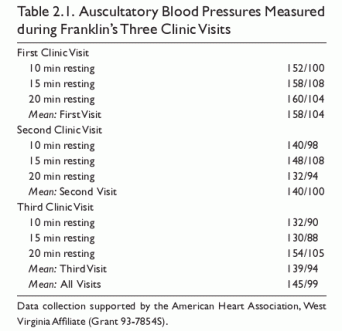
This is not surprising, as blood pressures are known to decrease with repeated measurement (Carey et al., 1976). Second, the final blood pressure recording of the third day was quite elevated in comparison to the earlier values obtained on the same day, warranting a closer inspection of clinic records to determine any source for this anomaly.
The clinic nurse indicated in her chart note that Franklin was late for work on that day and became increasingly impatient to complete the blood pressure measurement session, leaving without rescheduling as soon as the final reading was obtained. Therefore, these data revealed not only that this patient met the diagnostic criteria for essential hypertension, but that his blood pressure level was responsive to stressful situations.
Although Franklin’s physician was justified in commencing treatment for his hypertensive condition given the magnitude of his elevated blood pressures, clinic records of this type yield information only about a patient’s blood pressure while he or she is sitting quietly in the clinic. Presumably, these elevated arterial pressures would also be observed in environments outside of the clinic, including Franklin’s home and work environments. In order to evaluate the truth behind this assumption, blood pressure measures needed to be acquired outside of the clinic with instruments that do not require clinic personnel for their operation.