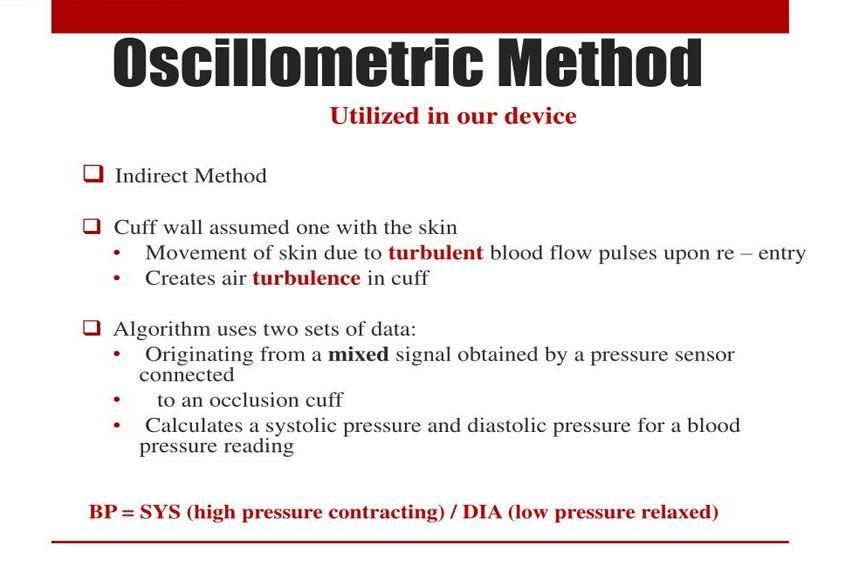
The oscillometric method of measuring blood pressure with an automated cuff yields valid estimates of mean pressure but questionable estimates of systolic and diastolic pressures. Existing algorithms are sensitive to differences in pulse pressure and artery stiffness. Some are closely guarded trade secrets. Accurate extraction of systolic and diastolic pressures from the envelope of cuff pressure oscillations remains an open problem in biomedical engineering.
A second type of noninvasive blood pressure measurement strategy, the oscillometric method, also employs an occluding cuff. However, in contrast to the auscultatory method, which relies on detection of Korotkoff sounds, the oscillometric method operates by sensing the magnitude of oscillations caused by the blood as it begins to flow again into the limb.
Typically, very faint blood flow oscillations begin to be detected as the air pressure in the cuff coincides with SBP. As air pressure is slowly released from the occluding cuff, the amplitude of these pulsatile oscillations increases to a point and then decreases as blood flow to the limb normalizes. Although the oscillation with the greatest amplitude has been shown to correspond reliably with mean arterial pressure (Mauck et al., 1980), determinations of SBP, which are associated with a marked increase in amplitude of oscillations, and DBP, which are associated with the point at which oscillations level off, are often less accurate when compared with auscultatory measures (Fowler et al., 1991).
Therefore, while oscillometric methods tend to overestimate SBP and underestimate DBP (Maheswaran et al., 1988; Manolio et al., 1988), they can be useful for determining accurate estimates of mean arterial pressure.
How trustworthy is automated noninvasive blood pressure monitoring?
We all are trained to measure our patients’ vital signs ourselves. The process of holding your patient’s arm close to your side with your elbow, placing the cuff, pumping it up, and deflating it while listening to the brachial artery with your stethoscope adds an intimacy to the physical exam and a way of slowing down an otherwise hectic encounter.
However, most vital signs are now obtained using automated techniques, thanks to the necessity of repetitive measurements and caregivers’ limited time. The nurse or aide rolls the noninvasive machine in, places the cuff on the patient’s arm, pushes a button, records the numbers, and rolls off to the next patient. The doctor or allied health provider looks at the numbers and decides if any therapeutic action is required. We put a lot of stock in these numbers. Just how accurate are they?
Most noninvasive blood pressure monitors use the oscillometric technique. The cuff is placed on the patient’s arm, and the cuff bladder is inflated with air until the external pressure exceeds the intra-arterial systolic pressure and arterial flow past the cuff ceases. The cuff bladder pressure is slowly released. A pressure sensor inside the cuff detects arterial pulsations as oscillations. As the cuff pressure declines, the oscillations increase in amplitude to a maximum, which represents the mean arterial pressure (MAP). The oscillation amplitude then declines until minimal. The only pressure actually measured is the pressure at the point of maximal amplitude, which corresponds to the MAP.
To summarize, automated noninvasive blood pressure and pulse measurements are here to stay. It is important to recognize the potential for inaccuracies, and attempt to confirm abnormal or unexpected measurements before plunging ahead with treatment.
Smartphone-based blood pressure monitoring via the oscillometric finger-pressing method
High blood pressure (BP) is a major risk factor for strokes and heart disease that is treatable with lifestyle changes and medication. However, hypertension awareness and control rates are low. Only ~55% of hypertensives in developed nations and ~45% of hypertensives in developing nations are aware of their condition, and ~15% of hypertensives have their BP under control. Ubiquitous BP monitoring technology could improve hypertension awareness by providing serial measurements from the mass population during daily life and enhance hypertension control by providing continual feedback to the individual patient. However, existing noninvasive devices require an inflatable cuff and therefore are not feasible for such anytime, anywhere monitoring of BP.
We proposed to extend the oscillometric principle, which is the basis of most automatic cuff-based BP measurement devices (6, 7), for cuff-less BP measurement using a smartphone. In this scenario, the user serves as the actuator (instead of the cuff) by pressing her/his finger against the phone to vary the external pressure of the underlying artery, whereas the phone serves as the sensor (rather than the cuff) to measure the resulting variable-amplitude blood volume variations or oscillations and applied pressure. The phone also provides visual feedback to guide the amount of finger pressure applied over time and computes BP from the measurements.
To investigate the oscillometric finger-pressing method, we developed a smartphone-based device to implement the method in real time. We then prospectively tested the device in human subjects for usability and accuracy against a standard cuff device. We likewise tested a finger cuff device, which uses the volume-clamp method, to determine BP. Our results indicate that smartphone-based BP monitoring is easily performed via finger actuation and can measure BP with accuracy similar to the finger cuff device.
Link
Science Translational Medicine 07 Mar 2018:
Vol. 10, Issue 431, eaap8674
The medical research regarding hypertension has fairly changed during the last two decades. Around the year 1990, the diastolic blood pressure was the most important value to look at, approximately 10 years later the focus was on the systolic blood pressure. Today, we know that both systolic and diastolic blood pressures are prognostically important. But other vascular parameters seem to be of importance for evaluating the hypertensive patient with respect to his prognosis and potentially therapeutical options. With the beginning of the new millennium the topic of arterial stiffness of major vessels related to hypertension slowly arose in clinical practise. This issue was together with its indicators for the first time mentioned in the ESH–ESC (European Society of Hypertension–European Society of Cardiology) guidelines for hypertension treatment in the year 2003. As parameters to measure arterial stiffness primary the methods of pulse wave analysis and pulse wave velocity have been suggested. The pulse wave analysis evaluates shape and amplitude of the aortic pulse wave.
According to another study that the measurements for AIx and aSBP agree for the suggested methods. The shown equivalence between both measuring devices recommends the use of ARCSolver algorithms in oscillometric methods. Actually, there are two upcoming commercial devices using the method (CardioMon by Medifina, Vienna, Austria and Mobil-O-Graph NG—ABPM by IEM, Stolberg, Germany). In addition, further invasive comparisons should be performed to prove the actual evidence. The principal easiness of clinical appliance provided by oscillometric methods offer the opportunity for wide spread use. This may ultimately lead to an improvement in common efforts to prevent cardiovascular disease.
A new oscillometric method for pulse wave analysis: comparison with a common tonometric method
The gold reference standard for blood pressure (BP) measurement is based on direct measurement of BP via an intra-arterial catheter placed in the radial artery. However, because this invasive procedure is inconvenient and involves some risk to the patient, an alternative compromise solution is based on classical sphygmomanometry where a cuff placed on the upper arm is inflated to a pressure well above systolic pressure and then allowed to deflate at a steady 2-3mm per second. A stethoscope is placed over the brachial artery just below the edge of the occluding cuff and as the cuff pressure falls, blood begins to flow and Korotkoff sounds are heard. The first Korotkoff sound defines the systolic pressure point, and the disappearance of the Korotkoff sounds, as the cuff is further deflated, defines diastolic pressure.