Because patients with isolated clinic hypertension have presumably less risk for cardiovascular complications than essential hypertensive patients, there is a question about whether treatment is necessary in this group. Additionally, there have been some reports that anti-hypertensive treatments are less effective in decreasing blood pressures observed in isolated clinic hypertensive patients (Fitscha and Meisner, 1993; Pickering et al., 1994). Therefore, in order to make optimal treatment recommendations, it is important for the physician to distinguish isolated clinic hypertensive patients from those with established hypertension.
Unfortunately, there are few guidelines that will assist a physician in making this distinction. For example, although it is known that more women than men exhibit isolated clinic hypertension (Myers and Reeves, 1995; Pickering et al., 1988), this information is not very useful for determining the appropriate diagnosis when examining a new hypertensive patient in the clinic. It has also been reported that isolated clinic hypertension is more frequent among nonsmokers, and among persons with low clinic DBP and low left ventricular mass (Verdecchia et al., 2001).
Knowledge of these variables, too, provides the physician with very little guidance in establishing an appropriate diagnosis and treatment plan. Physicians are not going to dismiss a new patient as having isolated clinic hypertension and not offer treatment just because she is a nonsmoker. As stated above, there is also no evidence that obtaining measures of self-reported anxiety yields any helpful information to the physician regarding making this distinction (Gerardi et al., 1985; Siegel et al., 1990).
After examining the literature on isolated clinic hypertension, Verdecchia et al. (2003) derived the following list of factors that might cue a physician to consider the presence of isolated clinic hypertension and recommend ambulatory blood pressure monitoring: female gender, nonsmoking status, newly diagnosed hypertension, limited exposure to clinic settings, and low left ventricular mass. In an analysis of potential predictors of isolated clinic hypertension, Larkin et al.
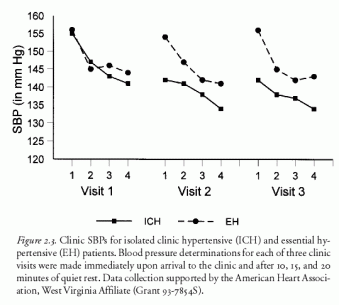
Figure 2.3. Clinic SBPs for isolated clinic hypertensive (ICH) and essential hypertensive (EH) patients. Blood pressure determinations for each of three clinic visits were made immediately upon arrival to the clinic and after 10, 15, and 20 minutes of quiet rest. Data collection supported by the American Heart Association, West Virginia Affiliate (Grant 93-7854 S).
(1998b) confirmed that there is very little the physician can do during an initial clinic visit that can corroborate presence of isolated clinic hypertension. From a wide range of potential predictors of isolated clinic hypertension in this study, only two strategies were found to discriminate isolated clinic hypertension from sustained essential hypertension, home blood pressure monitoring and the degree of blood pressure habituation across clinic visits.
Obviously, isolated clinic hypertensive patients reported lower blood pressures during a week of home blood pressure monitoring in comparison to the sustained hypertensive group. Regarding the degree of habituation across clinic visits, although SBPs of patients with isolated clinic hypertension were indistinguishable from essential hypertensive patients during the first visit to the clinic, they tended to habituate during subsequent visits as the patients grew accustomed to the clinic environment (see Figure 2.3). A comparable effect, however, was not observed for DBP.
